Behringer DR600
What it is
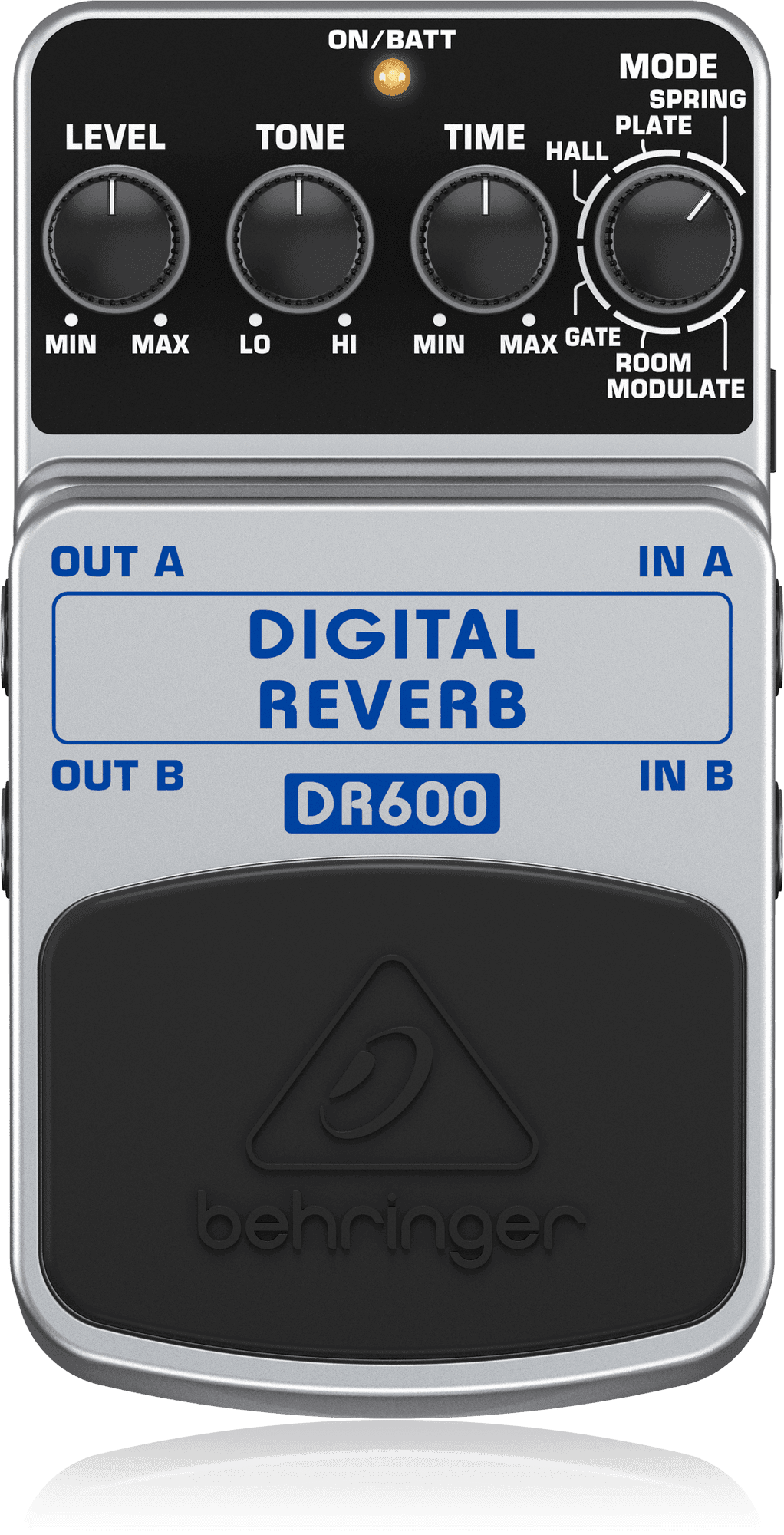
The DR600 is a digital stereo reverb pedal made by Behringer. It offers six modes (Spring, Plate, Hall, Gate, Room and Modulate), with LEVEL, TONE, TIME and MODE controls and a single footswitch. It has two 1/4 inch inputs and two 1/4 inch outputs, so it can process a signal in stereo or in mono. Behringer's feature list describes Hall as a very bright reverb that simulates concert hall reflections, and describes Modulate as having a choir-like quality. Retailers and reviewers compare the pedal to the Boss RV series and note its low price. Reviewers consistently point out its plastic housing and its lack of true bypass. Opinions on how natural the reverbs sound are divided. Some reviewers praised the sound as transparent, and others called the reverbs tinny or heavy. The pedal has no power switch, so the power draw continues until the IN jack is unplugged. Some reviewers reported that the pedal failed after light use. The sources I reviewed do not give the year of release or a detailed production history.
Specifications
- Type
- Digital stereo reverb, 24-bit
- Modes
- Spring, Plate, Hall, Gate, Room, Modulate
- Controls
- MODE, LEVEL, TONE, TIME, and a footswitch
- LED
- ON/BATT LED shows effect on status and battery level
- Inputs
- IN A and IN B, 1/4 inch TS, 500 kOhm each; use IN A alone for mono
- Outputs
- OUT A and OUT B, 1/4 inch TS, 1 kOhm each; use OUT A alone for mono
- Power
- 9 V battery (6LR61) or 9 V regulated DC supply; battery and supply not included
- Recommended supply
- Behringer PSU-SB (9 V, 100 mA) per manufacturer page and B&H; Long McQuade and Adorama list PSU-HSB-ALL
- Power consumption
- 90 mA
- Weight
- Under one pound, per one retailer
How it's used
Guitarists use the DR600 when an amplifier lacks reverb or has a weak built-in reverb, and it is placed in an effects loop or on a pedalboard. Reviewers also used it with keyboards, digital pianos and a synthesizer, and as a stereo reverb with two amplifiers. Reviewers describe home practice, songwriting and studio experimentation, and one professional musician reported using it on a gig pedalboard.
Suggested usage
Power
A regulated 9 V supply is preferable to a battery. One reviewer reported that the pedal drained batteries quickly, and another reported that the battery light began flickering after about 2.5 hours on a fresh battery.
Power off
There is no power switch. Unplug the IN jack when you finish to stop the drain on the battery.
Battery changes
Several reviewers found the battery compartment on the bottom awkward to reach because the footswitch area is in the way. Plan battery changes accordingly.
Subtle reverb
Reviewers found it hard to set a subtle reverb. Lower the TIME and LEVEL settings and adjust TONE to shape the sound.
Treble
TONE can roll off treble on the reverb signal, which one reviewer found useful.
Mono and stereo
For mono, use IN A and OUT A. For stereo, use both inputs and both outputs, with two amplifiers or a stereo signal path.
Gate mode
Gate cuts the reverb tail after a set time, which suits rhythmic effects according to Behringer's description.
What reviewers said
- ReverbZone
The site shows a score of 80 out of 100 from 44 reviews. Many reviewers praised value and sound, while others criticized the plastic build, the battery setup, and the difficulty of getting very subtle reverb.
- Thomann
The page shows 282 reviews, and opinions are split. Some reviewers found the sounds rich and good value, while others called the reverbs heavy and not subtle, and one said the plastic casing feels cheap.
- Long McQuade
The page shows a rating of 2.5 out of 5 from 3 reviews. One reviewer found the sustain weak and the settings hard to tell apart.
- Equipboard
The page shows a rating of 4.0 from 26 ratings. One reviewer called the pedal generally good value but not as versatile as expected, and another said some modes sound too similar.
- Sweetwater
Reviews range from very positive to very negative. One user described the reverbs as tinny and artificial, and another said the pedal tamed a tube amplifier's reverb well.
- Audiofanzine
One reviewer described the sound as transparent and said the pedal sounded better than many onboard amplifier reverbs.
Sources
- DR600
- Behringer DR600 Digital Reverb Reviews
- Behringer DR600 Digital Stereo Reverb Guitar Effects Pedal
- Behringer - DR600 Digital Stereo Reverb Effects Pedal
- Behringer DR600 Digital Reverb - What To Know & Where To Buy
- Behringer DR600 Digital Stereo Reverb User Reviews
- Behringer DR600 Digital Stereo Reverb Effects Pedal
- Behringer DR600 Digital Reverb Pedal Reviews
- Behringer DR600 Digital Reverb Pedal
- Behringer DR600 Digital Stereo Reverb Pedal 0709-ADM86-001 B&H
- Behringer Digital Reverb DR600 Stereo Effects Pedal 000-59700-00010
- Behringer DR600 Digital Reverb
- User reviews: Behringer Digital Reverb DR600 - Audiofanzine