Roland Juno-DS61
What it is
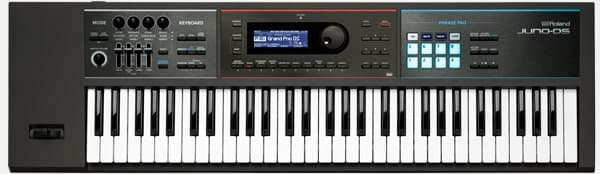
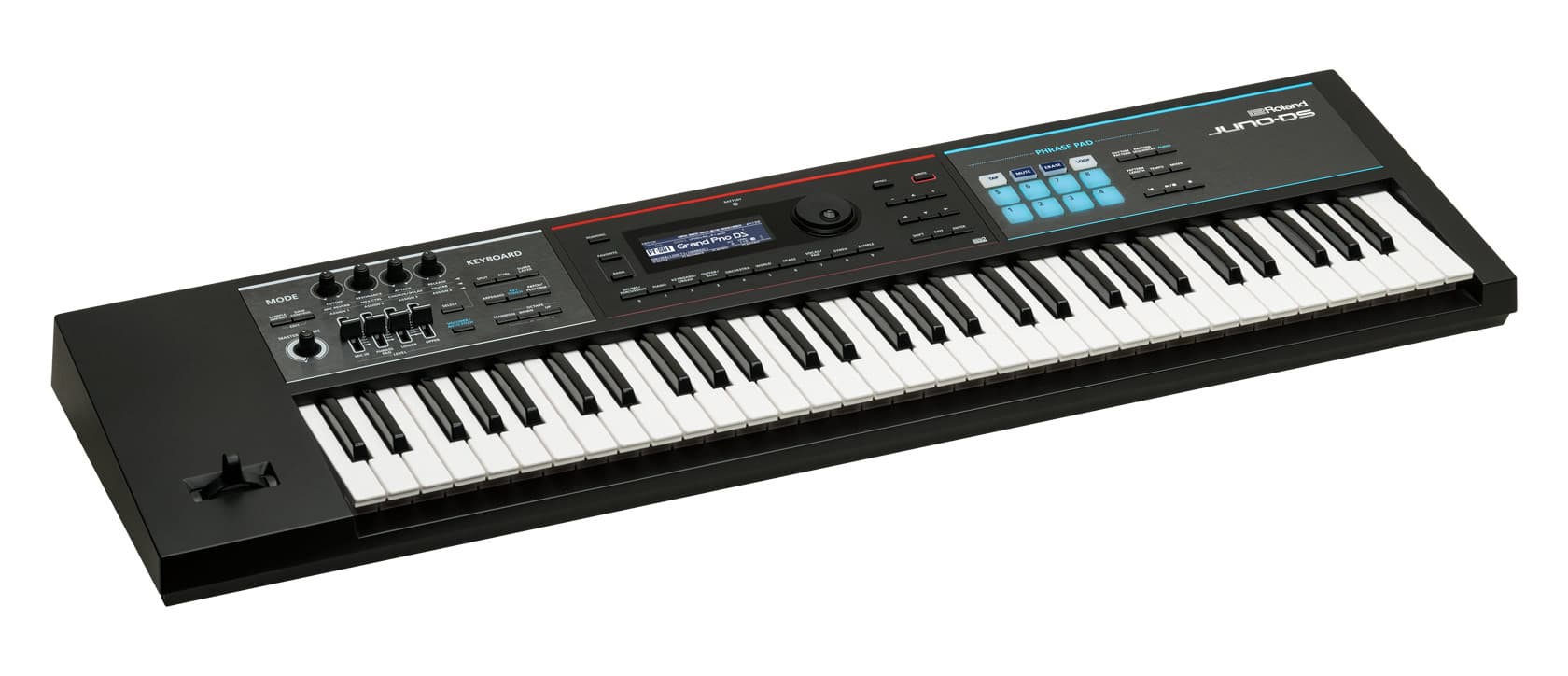
The JUNO-DS61 is a 61-key synthesizer in Roland's Juno-DS line, which also includes the 88-key DS88 and a 76-key DS76. Synthtopia, reporting from the 2016 NAMM Show, described the Juno-DS line as performance keyboards with synthesis that is less deep than Roland's hybrid analog/digital synths or its Boutique line, and with strength in live-oriented sounds, splits, and layers. Synthesizer Guide described the DS61 as essentially a smaller DS88 that shares much of its interface and button layout. Music Minds described it as far more portable than the 88-key version while keeping most of the same features. The main distinguishing trade-off is the key count. Synthesizer Guide said the smaller keyboard makes the controls more crowded and gives less fine control than the larger model. Sources differ on the keyboard action: Synthtopia says synth action, while Roland's specification lists 61 keys with velocity and Sweetwater describes velocity-sensitive keys. The velocity-sensitive reading is the one supported by Roland's own page. Roland's UK product page links to a gallery image labelled "rev1," which suggests a hardware revision exists. None of the sources retrieved explains what changed between revisions.
Specifications
- Keyboard
- 61 keys with velocity
- Sound generator
- 128-voice maximum polyphony, 16 parts
- Preset memory
- Over 1,200 patches, over 30 drum kits, 64 performances; GM2-compatible sounds included
- User memory
- 256 patches, 8 drum kits, 128 performances, 100 favorites
- Wave expansion
- 1 slot for rewritable internal waveform memory, loaded via USB flash drive
- Sample import
- WAV (44.1 kHz, 16-bit); multi-sample supported with system program version 2.00 or later and JUNO-DS Tone Manager software
- Effects
- 3 multi-effect systems with 80 types, 3 chorus types, 5 reverb types, 8 microphone-input reverb types
- Audio file player
- WAV, AIFF, MP3
- Rhythm and arpeggio
- 30 rhythm pattern groups of 8 patterns; 128 arpeggio presets
- Controllers
- Pitch bend/modulation lever, 4 control knobs, 4 level sliders, 8 multicolor pads
- Display
- Graphic LCD, 256 × 80 dots
- Storage
- USB flash drive port (USB 2.0 Hi-Speed)
- Connectors
- Sustain/hold pedal jack, expression pedal jack, microphone input (1/4-inch), external input (stereo mini), line outputs L/MONO and R (1/4-inch), headphone jack (stereo 1/4-inch), MIDI in and out, USB memory port, USB computer port (MIDI and audio), DC in
- Power
- DC 9 V from AC adaptor or 8 rechargeable Ni-MH AA batteries (sold separately); carbon-zinc and alkaline cells not supported; 600 mA current draw
- Battery life (Roland's figures)
- About 5 hours with 1,900 mAh batteries; about 4 hours with a USB flash drive connected
- Dimensions
- 1,008 mm wide × 300 mm deep × 97 mm high (39-11/16 × 11-13/16 × 3-7/8 in)
- Weight
- 5.3 kg (11 lb 12 oz), excluding AC adaptor
- Included
- Owner's manual, safety leaflet, AC adaptor, power cord
- Optional accessories
- Keyboard stands KS-11Z and KS-13, DP-series pedal switch, EV-5 expression pedal, Roland-branded USB flash memory
How it's used
Musicians use the DS61 for gigging and touring because of its light weight and battery operation. Synthesizer Guide says its smaller size suits travelers who still need a serious instrument. Its sound library includes the sounds from the earlier JUNO-Di, plus updated acoustic and electric pianos, extra organs, and other stage sounds. Music Minds describes dedicated microphone-input reverb, auto pitch, and vocoder features for vocalists, and says the built-in 8-track sequencer and USB audio/MIDI interface let users record audio and MIDI together. Music Minds names educators, producers, and home hobbyists as likely users. Synthtopia's NAMM demo emphasized splits, layers, and live sounds.
Suggested usage
Load additional waveforms
Roland offers free waveforms on its Axial sound library site. Load them into the single wave slot by USB flash drive, or import your own WAV files with the sample import function.
Use the AC adaptor for long sessions
Roland's figures show battery life drops when a flash drive is connected. Use only rechargeable Ni-MH cells, since carbon-zinc and alkaline cells are not supported.
Learn the vocoder and arpeggiator menus first
Music Minds says the vocoder and arpeggiator settings are hard to find, so allow time to learn the menus before a performance.
Plan around the compact layout
Synthesizer Guide notes that the controls are more crowded than on the 88-key model and that the keys offer less fine control. Check that a stand and sustain pedal are included in the setup if needed, since Roland sells these as options.
What reviewers said
- Synthesizer Guide
The reviewer first found the keyboard more cramped than the DS88, then concluded the DS61 deserves a place among the better 61-key synths and is comparable to the DS88 on sound. The reviewer praised its build quality and durability and called the DS88 the stronger choice only for those who want more keys and control.
- Music Minds
The review gave an expert score of 9.8, with sound rated 8.6/10, price 9.6/10, and look 9.4/10. It praised the custom tones and low price, and named the hard-to-find vocoder and arpeggiator settings as the main drawback.